
Nowruz: The Persian New Year Table Explained
Nowruz is the Iranian celebration of renewal: a spring new year shaped by astronomy, family rituals, poetry, food and the careful symbolism of the Haft-Seen table.
On the first day of spring, homes across Iran feel subtly different. Windows have been cleaned, new clothes are ready, bowls of green shoots have been growing for days and a table has been arranged with objects whose meanings reach far beyond decoration. Families watch the clock for the exact moment of the vernal equinox. When it arrives, they exchange greetings, embrace, give gifts and begin a season of visits that connects generations.
Nowruz—often translated as “new day”—is both ancient and thoroughly alive. It is not a historical performance preserved for visitors. It is a changing family tradition practised in cities, villages and Iranian communities around the world. Some households build an elaborate Haft-Seen, others arrange a modest one. Recipes and visiting customs differ by region and family. What unites them is the idea that the year should begin with attention: attention to the home, to relationships, to memory and to the possibility of starting again.
The equinox sets the time
Unlike a fixed-date celebration, the Iranian new year begins at the precise astronomical moment when the sun crosses the celestial equator and spring starts in the Northern Hemisphere. That moment can fall at different hours of the day or night. Calendars publish the exact time, television programmes count down to it and families try to gather around the Haft-Seen before it arrives.
This connection to the equinox gives Nowruz a distinctive rhythm. The celebration is rooted in seasonal change rather than a symbolic date selected independently of nature. Longer daylight, fresh growth and warmer weather are not background details; they are part of the meaning. The Persian calendar’s first month, Farvardin, begins with this astronomical transition.
The long history of Nowruz crosses dynasties, languages, religions and modern borders. It is celebrated in different forms across a wide cultural region. That breadth is important, but so is avoiding a single, simplified origin story. Traditions accumulate. Court ceremony, agricultural cycles, Zoroastrian associations, local customs and modern family life have all contributed to what people call Nowruz today.
Before the new year: preparing the home
The celebration begins well before the equinox. One of the best-known preparations is khaneh tekani, literally “shaking the house”: a thorough spring cleaning that may involve washing textiles, clearing cupboards, repairing small problems and making the home ready for guests. The practical work carries a symbolic idea—stale or neglected things should not be carried carelessly into the new year.
Shopping also changes pace. Markets fill with flowers, sweets, nuts, new clothing and the objects needed for Haft-Seen. Goldfish have traditionally appeared on many tables, although concern for animal welfare has led some families to reconsider the custom or use a decorative alternative. The important lesson for a visitor is that there is no single official table enforced in every household. Traditions are discussed, adapted and sometimes disputed.
In the final days of the old year, fire and movement enter the calendar through Chaharshanbe Suri, celebrated on the eve of the last Wednesday. Practices vary, and modern fireworks have changed the atmosphere in many cities. The older image of people jumping over small fires is associated with leaving pallor or weakness behind and taking warmth and vitality into the year ahead. Visitors should observe local safety guidance; crowded streets and improvised fireworks are not a setting for casual risk.
Reading the Haft-Seen table
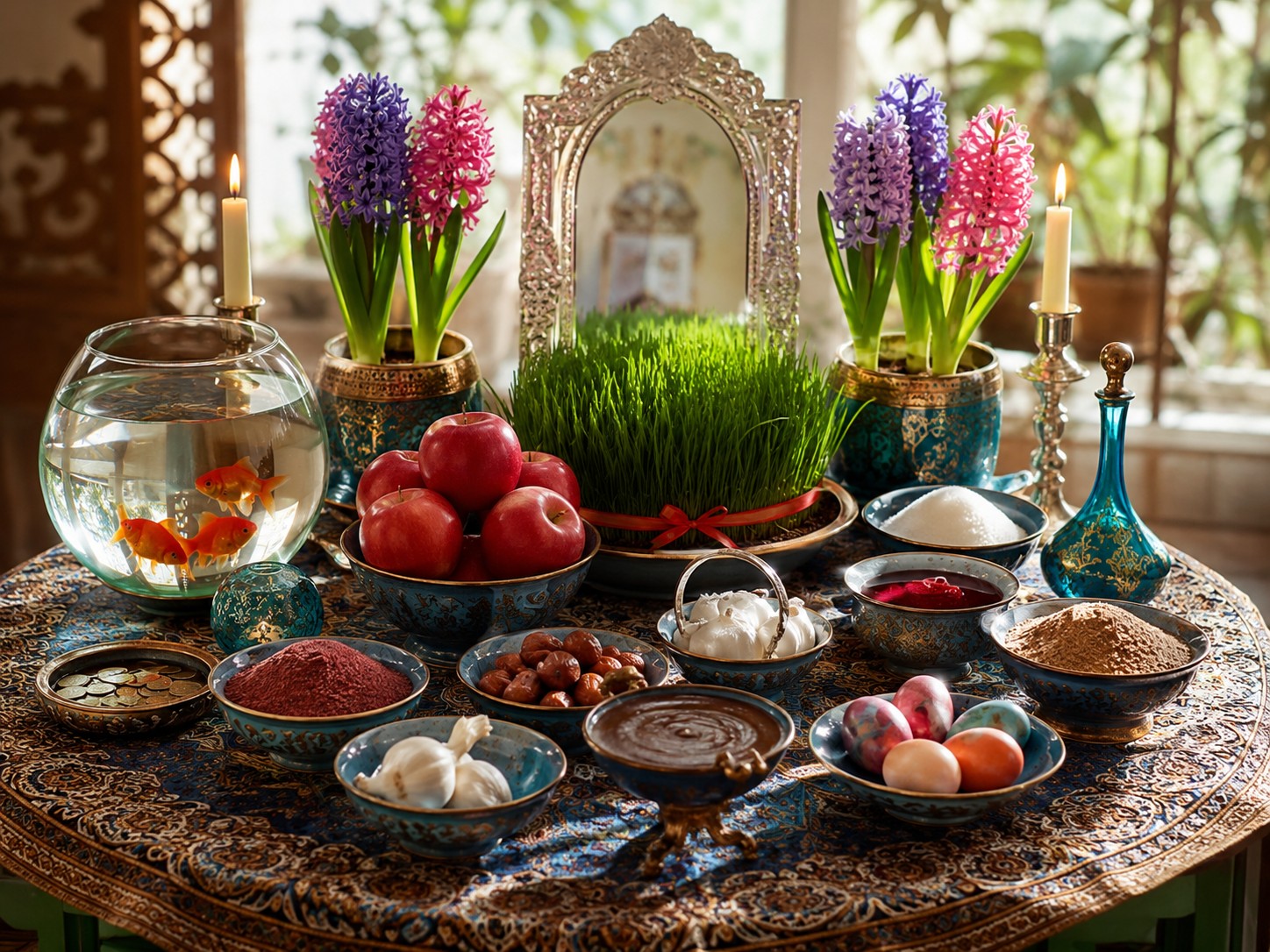
The name Haft-Seen means “seven S’s”. At its centre are seven items whose Persian names begin with the letter sin. The exact selection can vary, but a widely recognised table includes sabzeh, sib, senjed, serkeh, samanu, somāq and sir. Each object gathers layers of popular interpretation rather than one universally fixed definition.
Sabzeh: visible renewal
Sprouted wheat, lentils or another seed form the green heart of the table. Families begin growing sabzeh in advance, watching ordinary grains become a dense patch of new life. It is the most immediate expression of spring: fragile, temporary and bright. At the end of the holiday period, the sprouts are taken outdoors as part of Sizdah Bedar.
Sib, senjed and sir
Apples bring colour, fragrance and associations with beauty or health. Senjed, the dried fruit of the oleaster tree, is often connected in popular explanations with love, affection or considered choice. Garlic can represent health and protection. These meanings are not museum labels; families may describe them differently, and that flexibility is part of living tradition.
Serkeh, samanu and somāq
Vinegar is commonly associated with patience, age and acceptance of life’s changes. Samanu, a sweet paste made from germinated wheat, requires time and work; it is linked with strength, abundance and the transformation hidden inside a seed. Sumac, with its deep red colour and sharp taste, is sometimes connected to sunrise and the victory of light.
Beyond the seven S’s, the table often includes a mirror, candles, painted eggs, coins, flowers, sweets, a poetry book or a sacred text. A bowl of water may hold an orange or another floating object. Hyacinths add perfume and colour. A copy of Hafez is common in many homes, while other families place the Quran or another meaningful book. The result is personal: part seasonal altar, part family portrait and part design project.
Food, visits and the social calendar
Nowruz is not contained on the table. It reorganises social time. In the days after the new year, younger family members traditionally visit older relatives, and the visits are returned. Children may receive cash gifts in crisp notes. Bowls of mixed nuts, fruit and sweets appear repeatedly, and hospitality can become almost continuous.
Food varies by region, but herbs, rice and fish are widely associated with the new year meal. Sabzi polo, rice cooked with fresh herbs, is often served with fish. Reshteh polo, kuku sabzi and regional dishes also appear. The herbs reinforce the season’s green imagery, while family recipes turn a national celebration into something intimate and specific.
For travellers, this period can be rewarding and logistically complex. Domestic travel is intense, popular destinations become busy and accommodation may fill early. Government offices, museums, shops and transport can follow holiday schedules that change from day to day. A route that looks easy in an ordinary week may require much more preparation during Nowruz.
Sizdah Bedar: taking renewal outdoors
The thirteenth day of Farvardin is widely spent outdoors. Families gather in parks, gardens, countryside or any available green space for picnics and long afternoons together. The sabzeh grown for Haft-Seen is taken out of the home and traditionally returned to flowing water or nature, although environmentally responsible disposal matters more than repeating a custom in a way that causes litter or damages waterways.
Sizdah Bedar is sometimes described too quickly as a day for escaping the bad luck of thirteen. That explanation misses the social and seasonal richness of the occasion. The holiday period closes by leaving the interior space of the home and entering the spring landscape. It is loud, communal and practical: families cook, talk, play and extend the new year into public space.
Experiencing Nowruz respectfully
A visitor does not need to imitate every custom to appreciate the season. The best approach is curiosity without entitlement. If invited into a home, follow the host’s lead, bring a small gift when appropriate and ask before photographing people or private rituals. Learn a simple greeting such as Nowruz mobarak. Remember that a family gathering is not a staged cultural attraction.
Public Haft-Seen displays can be beautiful, but domestic tables often tell more personal stories through inherited dishes, family photographs or books chosen for their emotional significance. Ask open questions rather than insisting that every object must have one fixed meaning. People may joke about the effort involved, debate what “belongs” on the table or describe a tradition unique to their hometown.
Planning travel during the Iranian new year
Anyone considering Iran during Nowruz should plan early and keep the itinerary realistic. Major heritage cities can be crowded. Road traffic increases. Some restaurants and private businesses close while others operate at their busiest. Weather can vary from snowy mountain conditions to warm southern coastlines within the same holiday.
It is also important to verify current entry rules, transport schedules and the operating status of individual sites close to departure. Holiday information copied from a previous year may no longer be reliable. Flexible days and centrally located accommodation can reduce stress. A slower route often creates more meaningful encounters than attempting to cross the country while millions of residents are travelling too.
Why Nowruz endures
The strength of Nowruz lies in its ability to hold different scales of meaning at once. It is astronomical and domestic, ancient and contemporary, shared across borders and recreated in individual homes. Its symbols are recognisable, yet no two tables are exactly alike. The work of cleaning, sprouting seeds, cooking, visiting and returning outdoors turns an abstract wish for renewal into a sequence of physical acts.
For someone encountering the celebration for the first time, the Haft-Seen is a compelling doorway. Look closely, but then look beyond it: to the people arriving with sweets, the children waiting for gifts, the traffic heading toward family towns, the scent of herbs in the kitchen and the precise moment when everyone pauses for the year to change. That wider scene is Nowruz—a new day made meaningful because people prepare for it together.
Keep reading
The Asiatic Cheetah: Iran’s Rare Desert Icon
A graceful survivor of Iran’s open plains and one of the country’s most precious species.
Persian Carpets: Stories Woven by Hand
From garden motifs to regional colours, every carpet carries the memory of its maker.