
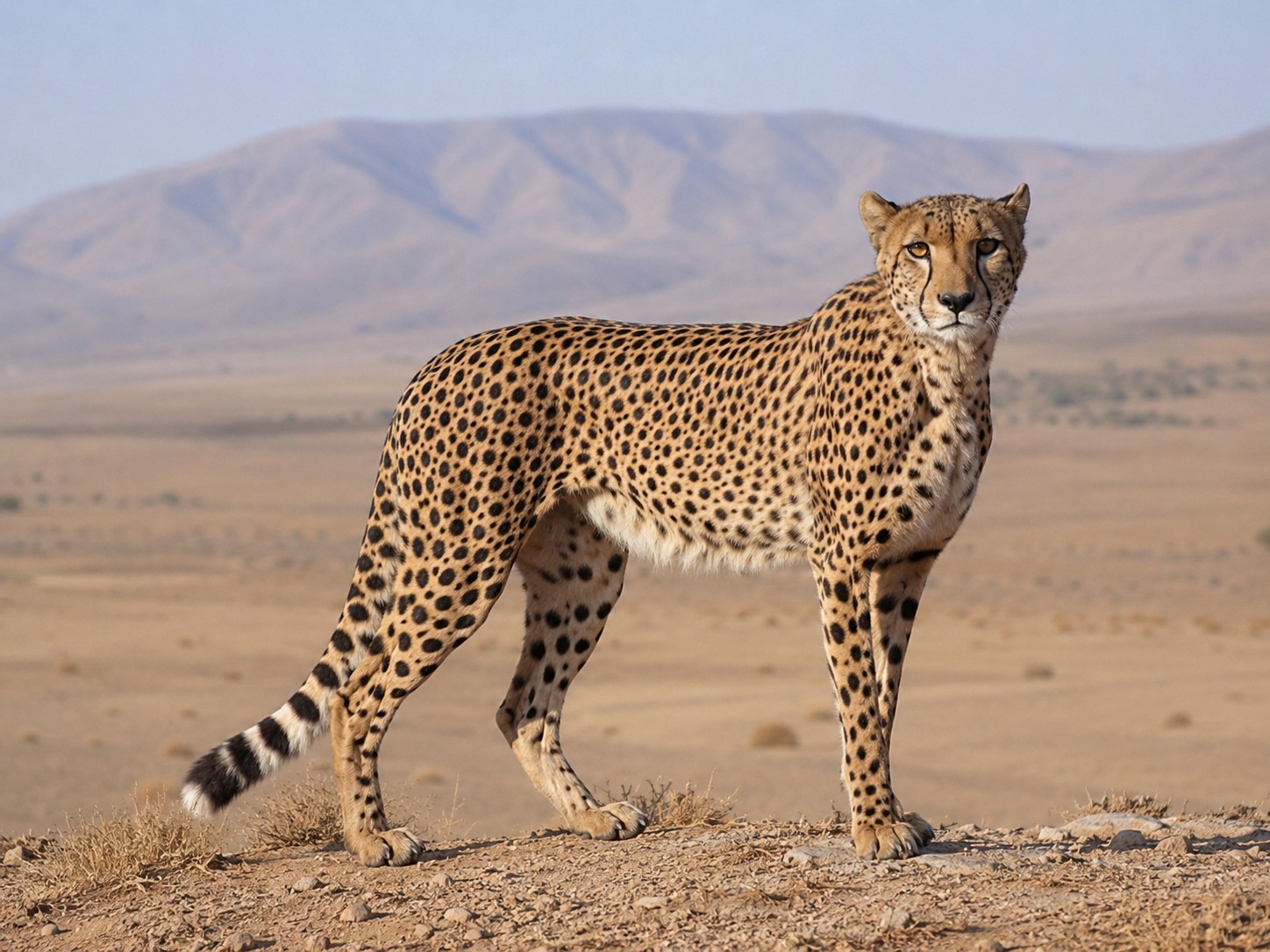
The Asiatic Cheetah: Iran’s Rare Desert Icon
The Asiatic cheetah is one of Iran’s most recognisable wild animals and one of its most vulnerable. Understanding it begins with the landscape, not with a promise of seeing one.
Across Iran’s dry central and eastern regions, distance is measured differently. Mountain ridges break into gravel plains, seasonal rivers disappear into desert basins and a road can run for kilometres without revealing how much life is moving beyond it. This scale is the world of the Asiatic cheetah: a wide-ranging predator whose survival depends on connected habitat, adequate prey and the ability to cross a landscape increasingly divided by roads and human activity.
The animal has become a national conservation symbol, appearing in public campaigns and on the shirts of Iranian football players. Recognition, however, does not remove danger. The remaining population is extremely small, and every individual matters. That reality changes the ethics of wildlife travel. A cheetah is not an attraction that a tour can responsibly guarantee. The meaningful experience is learning to read its habitat, understanding the work of conservation teams and recognising why a sighting—if it ever happens—must occur on the animal’s terms.
What makes the Asiatic cheetah distinct?
The Asiatic cheetah is the surviving Asian population of a species once distributed far beyond its present range. Cheetahs historically occurred across parts of the Middle East and into the Indian subcontinent. Habitat loss, declining prey, hunting and capture contributed to their disappearance from most of that range. Today, Iran is the last country where the Asiatic form persists in the wild.
Like other cheetahs, it is built for speed: a light frame, deep chest, long limbs, flexible spine and a tail that helps balance rapid changes of direction. Dark lines run from the inner eyes toward the mouth, reducing glare and giving the face its instantly recognisable expression. Yet speed should not dominate the story. A short sprint is energy-intensive. Successful survival depends more often on avoiding disturbance, finding prey, moving between safe areas and raising cubs through vulnerable early months.
Popular comparisons between Asiatic and African cheetahs can become too confident because very small populations are difficult to study. Coat, body size and ecological behaviour may vary, but conservation does not depend on turning the animal into a dramatic visual exception. Its importance comes from being the last wild representative of a once much wider Asian range.
A landscape larger than a protected area
A protected boundary on a map cannot contain every need of a wide-ranging carnivore. Cheetahs move through mosaics of national parks, wildlife refuges, grazing land, road corridors, mines and areas of human settlement. This movement is necessary for finding prey and mates, but it brings risk.
Iran’s arid ecosystems support species adapted to low rainfall and extreme temperature variation. Gazelles and wild sheep can form part of the prey base, alongside smaller animals where conditions allow. When prey numbers fall through poaching, habitat change or competition, predators are affected even if they are not targeted directly. Protecting a cheetah therefore means protecting ecological relationships across a much larger system.
Water is another crucial element. In dry regions, springs and artificial water points may concentrate wildlife and human activity. Their placement and management can alter animal movement. Conservation decisions need long-term field knowledge rather than simple assumptions that more water in every location will always help.
Roads: connection for people, danger for wildlife
Road collisions are one of the clearest threats to wide-ranging wildlife. A road can cut through a movement corridor that animals have used for generations. At night, speed and limited visibility make crossings especially dangerous. Warning signs alone may not be enough if drivers do not slow down or if fencing channels animals toward unsafe points.
Effective mitigation can include carefully designed crossings, fencing that guides rather than traps animals, speed reduction, lighting decisions and monitoring to identify where movement actually occurs. Measures must suit local ecology. A crossing built in the wrong place may look impressive while doing little for the species it is intended to protect.
For travellers, responsible behaviour is straightforward: respect speed limits, avoid driving unnecessarily after dark in sensitive zones, do not stop in dangerous road positions and never chase an animal with a vehicle. A fleeting photograph is not worth increasing stress or collision risk.
Monitoring an animal that is rarely seen
Conservation teams do not rely only on direct sightings. Camera traps, tracks, scat, genetic analysis and reports from rangers and local communities help build a picture of where animals move. Each method has limits. Camera placement can bias results, tracks can be difficult to interpret and a lack of images does not prove that an area is empty.
Individual cheetahs may be identified from spot patterns, allowing researchers to compare records over time. This can reveal movement between areas or confirm that an animal is still alive. Yet monitoring a tiny population involves uncertainty. Public numbers may change as methods improve, new evidence appears or previously known individuals are no longer recorded.
That uncertainty should be communicated honestly. Conservation is not helped by sensational claims that alternate between miracle recovery and immediate extinction. The situation is urgent, but accurate reporting matters because funding, public trust and field priorities depend on it.
The role of local communities and rangers
People living and working near cheetah habitat are not an abstract “human pressure.” They include pastoralists, village residents, road users, miners, rangers, researchers and families whose livelihoods are connected to the same land. Durable conservation requires their knowledge and participation.
Rangers often work across enormous territories in difficult conditions. Their responsibilities can include patrols, wildlife monitoring, responding to injured animals, enforcing regulations and communicating with local communities. Equipment, training, staffing and institutional support affect what they can accomplish.
Community-based projects may support alternative livelihoods, environmental education or locally managed tourism. These initiatives need careful evaluation. Tourism can provide income and strengthen pride, but it can also concentrate disturbance, create unrealistic expectations or distribute benefits unfairly. A cheetah logo on a guesthouse is not automatically evidence of a conservation benefit.
Can travellers see an Asiatic cheetah?
No responsible operator should promise a sighting. The population is too small, the habitat too large and disturbance too consequential. Searching aggressively for an animal can interfere with movement or reveal sensitive locations. Exact location data should be treated cautiously, especially when it could assist poaching or uncontrolled visitation.
A conservation-minded journey can still be valuable. Travellers may visit desert landscapes with appropriate permission, learn about ecology from qualified people, observe more common wildlife from a safe distance and support services that demonstrate genuine local benefit. Interpretation can focus on tracks, prey species, geology, water and the challenges of maintaining habitat connectivity.
Photography should follow the same principle. Long lenses, patience and distance are preferable to approach. Feeding, calling, baiting or surrounding wildlife for an image is unacceptable. Drone use can disturb animals and may be restricted; it should never be assumed permissible.
How to evaluate a wildlife experience
Ask specific questions before booking. Who leads the wildlife component, and what is their experience? Does the route enter a protected or sensitive area, and are permissions required? How many vehicles or visitors operate together? What happens if no wildlife is seen? Where does the money go? Are exact cheetah locations shared publicly?
Good answers are usually calm and detailed. Be cautious with language such as “guaranteed,” “secret spot” or “close encounter.” Ethical wildlife travel is often less dramatic in advance because it refuses to script the behaviour of a wild animal.
A species that represents a system
The Asiatic cheetah matters in its own right, but it also draws attention to an entire arid ecosystem. Protecting movement corridors can benefit gazelles, wild sheep, foxes, birds and less visible species. Reducing road danger protects people as well as wildlife. Supporting rangers can strengthen the management of whole landscapes.
Conservation symbols are powerful when they lead beyond the symbol. The cheetah’s image can open a conversation, but survival depends on less visible work: monitoring, law enforcement, habitat planning, safer infrastructure, scientific disagreement, local trust and years of patient attention.
Travelling with humility
There is a particular form of respect in accepting that the rarest animal may remain unseen. The empty-looking plain is not a failed safari. It is habitat, a space in which wildlife still has room to choose distance. Learning to value that distance is one of the most important changes responsible tourism can make.
If an Asiatic cheetah crosses a camera trap months after a traveller has gone home, conservation has not missed an opportunity. The animal has moved without being followed. The landscape has retained some of its secrecy. For a species living so close to the edge, that may be the better story.
Keep reading

Nowruz: The Persian New Year Table Explained
Meet the Haft-Seen table and the rituals that welcome spring across Iran.

Persian Carpets: Stories Woven by Hand
From garden motifs to regional colours, every carpet carries the memory of its maker.