
Persian Carpets: Stories Woven by Hand
A Persian carpet is architecture in fibre: a field of knots where material, region, memory and design become inseparable. Learning to look is more valuable than memorising a list of famous names.
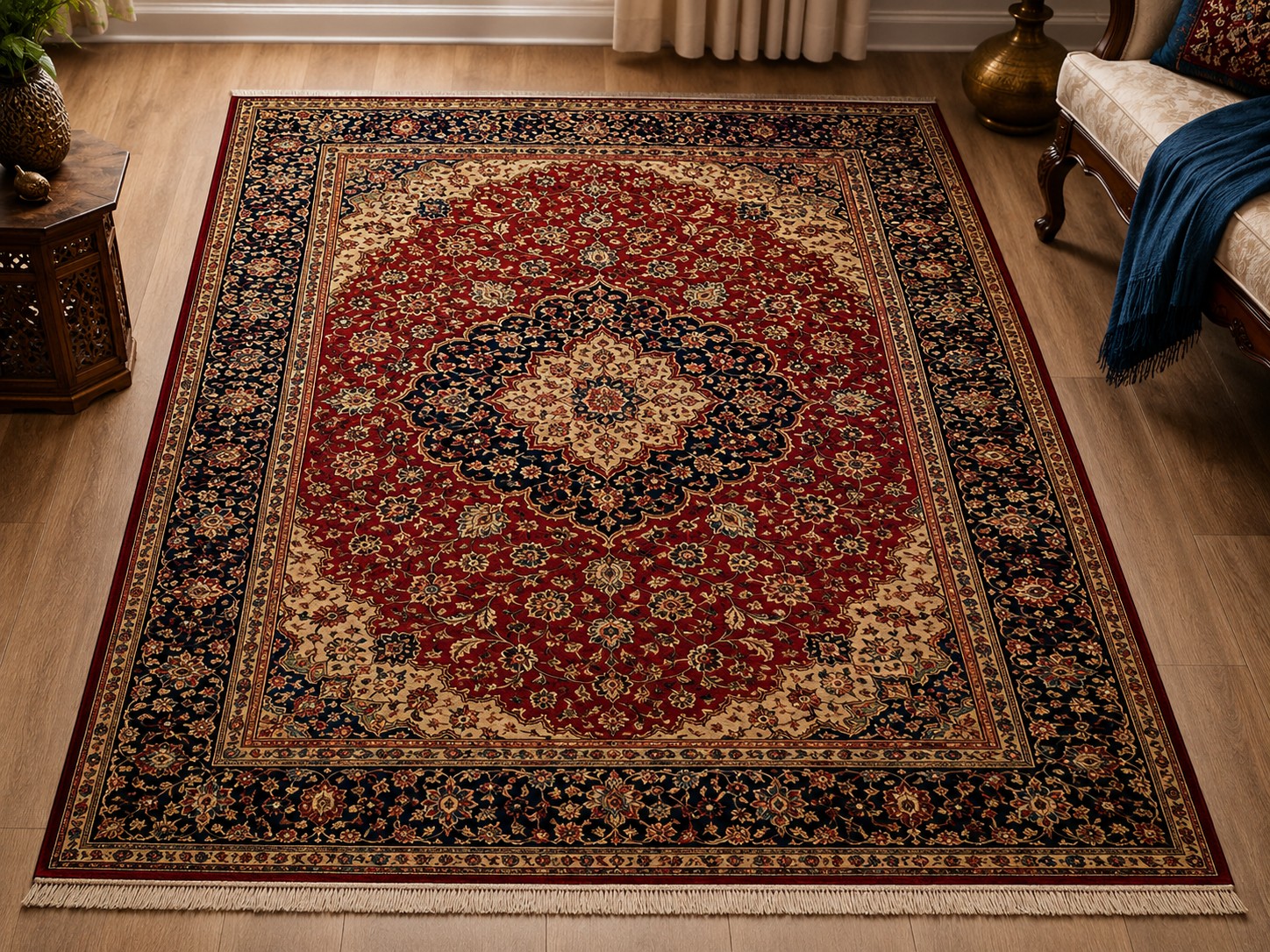
Stand in front of a hand-knotted carpet and the first impression may be colour: madder red, deep indigo, soft ivory or a green used sparingly because of its visual and cultural force. Step closer and the structure appears. Thousands or millions of knots hold the image together. A border regulates the edge. A medallion may organise the centre, or repeating motifs may refuse a single point of focus. Small irregularities reveal the movement of a hand rather than the output of a machine.
“Persian carpet” is a broad term. It can refer to workshop pieces made from detailed cartoons, village rugs whose geometry follows local habit, or nomadic weavings shaped by portable looms and remembered motifs. Materials, knot density, format and market history differ widely. The useful question is not whether one type is the authentic Persian carpet. It is what a particular piece can tell us about where, how and for whom it was made.
Carpet, rug and the language of structure
In everyday conversation, “carpet” and “rug” often overlap. Specialists may distinguish by size, construction or use, but terminology varies. More important is understanding the basic structure. In a piled carpet, lengthwise warp threads are stretched on a loom. Knots are tied around the warps row by row, and horizontal weft threads stabilise the fabric. The pile is cut and later trimmed to reveal the design.
Two knot structures are commonly described in discussions of Iranian carpets: the symmetrical knot and the asymmetrical knot. They are sometimes labelled “Turkish” and “Persian,” but those geographic labels can oversimplify practice. Weavers choose structures according to regional tradition, workshop method and the demands of the design. Knot count can indicate the potential for detail, but it is not a universal measure of artistic quality.
A finely knotted carpet can reproduce intricate curves, miniature figures and layered floral forms. A coarser village rug may achieve extraordinary power through proportion, colour and rhythm. Judging both by the same numerical standard is like judging a calligraphic manuscript and a carved wooden door by the thinness of their lines.
From cartoon to remembered pattern
In formal workshops, a design may be planned on a gridded cartoon. Each square corresponds to a knot colour, allowing multiple weavers to execute complex patterns with precision. The system supports large commissions and repeatable designs, although the quality of interpretation still depends on skilled hands, material preparation and careful finishing.
Other weavers work from partial guides, samples or memory. Motifs evolve as they are repeated. Scale shifts to fit a particular loom. A border may compress near the top, or an animal form may become more abstract over generations. These changes should not automatically be described as mistakes. They can be evidence of a living visual language.
Older writing about carpets sometimes romanticised an isolated weaver producing spontaneous symbols untouched by markets. Reality is more complex. Village and nomadic weaving has long interacted with trade, dealers, changing taste and household economics. Workshop production can also contain creativity. Respecting the maker means recognising labour and commercial context, not replacing them with a fantasy.
Designs that organise the field
Many formal carpets use a central medallion surrounded by corner elements and a layered border. Others repeat a motif across the field, creating a design that could appear to continue beyond the edges. Garden carpets divide the surface into channels and plots that evoke an ordered landscape. Prayer rugs may use an arch-like niche, although not every niche design was necessarily made or used for prayer.
Floral scrolls, palmettes, rosettes, cloud bands, vases, cypress trees, birds and animals appear in countless variations. The boteh—a curved form often compared to a leaf, flame or seed—became internationally familiar through the pattern called paisley. Geometric rugs may contain diamonds, hooked forms and protective motifs whose popular interpretations vary.
Symbol dictionaries should be used cautiously. A dealer or guide may declare that every colour and shape has one ancient meaning. In practice, meaning depends on region, period, context and the person explaining it. Some motifs carry recognised associations; others survive because they balance the composition, belong to a local repertoire or were requested by the market.
Colour: chemistry, landscape and time
Traditional dyes can be produced from plant, insect and mineral sources. Madder root is central to many reds; indigo creates blues through a complex vat process; pomegranate rind, walnut husk and other materials can contribute yellow, brown and related tones. Recipes depend on mordants, water, fibre and the experience of the dyer.
The phrase “natural dye” is not a guarantee of age or quality, and synthetic dye is not one single category. Modern chemistry entered carpet production in stages. Some early synthetic colours aged poorly, while others have remained stable. Contemporary weavers may use excellent natural dyes, reliable modern dyes or a considered combination.
One admired effect is abrash: subtle bands or shifts in colour created when yarn dyed in separate batches varies slightly. In the finished carpet, the change records the making process. Abrash can add depth, but it can also be imitated. Again, one feature should not determine the value of the whole piece.
Wool, silk and cotton
Wool is the most common pile material in many Iranian carpets. Its quality varies with breed, climate, shearing, spinning and treatment. Good wool can be resilient and luminous, holding colour while withstanding use. Cotton is often used for warp and weft because it provides a stable foundation. Silk allows extraordinary fineness and sheen but requires different care.
Labels such as “silk” deserve verification. Mercerised cotton or artificial fibres can produce shine that an inexperienced buyer may mistake for silk. Burn tests are destructive and inappropriate for a finished object; provenance, fibre knowledge and reputable assessment matter more than theatrical demonstrations in a shop.
Regions, cities and commercial names
Names such as Tabriz, Kashan, Isfahan, Kerman, Nain, Qom and Heriz are widely used in the carpet trade. They may indicate a city, a surrounding production area, a design family or a commercial category. Tribal and village names can be equally complicated. Migration, subcontracting and market demand blur simple geographic boundaries.
Broad tendencies still help. Some urban centres are associated with finely drawn floral work, silk detail or particular palettes. Village traditions may favour strong geometry and heavier wool. But a name should begin an investigation, not end it. Two carpets sold under the same regional label can differ enormously in age, material and execution.
How to look at a carpet
Begin from a distance. Does the composition feel balanced? Does your eye move across the surface, or collapse into one loud element? Then move closer. Look at line quality, colour transitions, the relationship between field and border and the clarity of small motifs. Turn a corner to see the direction of the pile change the colour.
Examine the back, where the knot structure and repairs are easier to see. Check whether the carpet lies flat. Look for uneven wear, moth damage, brittle foundation threads, colour run and areas that have been heavily restored. Restoration is not automatically negative, especially in an older piece, but it should be disclosed and reflected in the description.
Ask about dimensions measured without the fringe, materials, approximate age, condition and any known provenance. If age or origin materially affects the price, an unsupported story is not enough. Written information from a reputable seller is more useful than confident theatre.
Buying without losing the cultural experience
Carpet shopping can become an intense negotiation, particularly for a first-time visitor. Decide in advance whether you are seeking a usable contemporary rug, a decorative piece, a collectible textile or simply knowledge. Measure the intended space at home and carry the dimensions. Colours viewed under warm shop lighting may look different in daylight.
Do not buy because tea has been served or because a “special price” appears to expire in five minutes. Hospitality and commerce can coexist, but you are allowed to leave. Compare pieces, ask for the final price in a clearly understood currency and confirm payment, export and shipping arrangements. Regulations can depend on age, material, value and destination country, so current rules must be checked rather than assumed.
For high-value purchases, independent expertise may be worthwhile. A guide who receives commission from a shop should disclose it. The best cultural interpretation helps you understand the object even if you decide not to buy.
Care after the journey
Regular gentle vacuuming, rotation and protection from prolonged direct sunlight can extend a carpet’s life. Avoid aggressive home cleaning products. If the piece becomes wet, stained or damaged, consult a textile or rug specialist familiar with hand-knotted structures. Folding, rolling and storage methods depend on material and condition.
Use is not disrespect. Many carpets were made to live on floors, hold gatherings and accumulate family history. Others are fragile enough to require limited traffic or display. Care should follow the actual object, not a romantic rule applied to every weave.
A record of labour
It is easy to speak about carpets only through beauty and symbolism. The object is also concentrated labour: preparing fibre, spinning, dyeing, designing, tying, beating the weft, trimming, washing, transporting and selling. That labour may be distributed across many people whose names are not recorded.
Looking well means holding both realities together. A Persian carpet can be a dazzling work of design and a product shaped by household economics, global taste and unequal bargaining power. Asking who made it, how they were paid and how value moved through the supply chain is part of appreciating the work, not a distraction from it.
The reward for patient attention is that the carpet stops being a flat pattern. It becomes a place: wool carrying the memory of pasture, dye recording water and chemistry, motifs travelling between communities and a maker’s decisions held in every row. That is why no photograph, however detailed, can replace time spent standing close enough to see the knots.
Keep reading

The Asiatic Cheetah: Iran’s Rare Desert Icon
A graceful survivor of Iran’s open plains and one of the country’s most precious species.
Nowruz: The Persian New Year Table Explained
Meet the Haft-Seen table and the rituals that welcome spring across Iran.